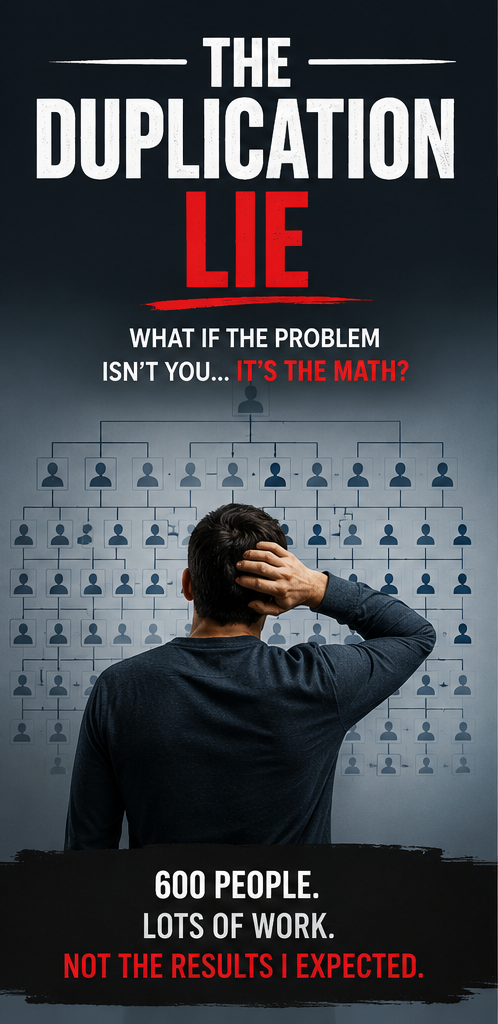

What If the Problem Isn’t You?
One of the biggest breakthroughs I ever had in business came from realizing something uncomfortable:
The problem wasn’t me.
For years, I thought it was.
Like many people getting started in home business, affiliate marketing, and online business opportunities, I was taught a simple formula:
Get two people.
Help them get two people.
Then help those people get two people.
Before long, you’ll have a huge organization and a life-changing income.
On paper, it looked brilliant.
The charts were impressive.
The projections were exciting.
The problem was that reality didn’t seem to cooperate.
The Dream Everyone Gets Sold
If you’ve ever looked at a compensation plan, you’ve probably seen some version of this chart.
You recruit two people.
Those two recruit two people.
Those four recruit two people.
Soon you’re looking at hundreds or even thousands of people in your organization.
The numbers get very large very quickly.
And that’s where the excitement comes from.
The chart makes it appear that success is simply a matter of time.
Just keep finding people and eventually duplication takes over.
At least that’s the theory.
My Real-World Experience
I spent years trying to make that theory work.
I attended meetings.
Made phone calls.
Followed up with prospects.
Helped train team members.
Did everything I was told to do.
Over time I built organizations that grew into the hundreds.
And yet something always felt off.
The income never seemed to match the size of the organization.
The bigger realization was this:
The vast majority of people weren’t doing much at all.
A small handful of people were producing most of the results.
At the time I thought maybe I just hadn’t found the secret.
Maybe I needed a better presentation.
Maybe I needed better training.
Maybe I needed a different script.
But years went by and the same pattern kept showing up.
The 80/20 Rule Explained Everything
Eventually I came across something called the Pareto Principle.
Most people know it as the 80/20 Rule.
The idea is simple:
In many areas of life, roughly 20% of the people produce 80% of the results.
You see it everywhere.
In sales.
In sports.
In business.
In investing.
And yes, in home business.
Suddenly everything made sense.
The problem wasn’t that duplication didn’t exist.
The problem was that it wasn’t happening the way the charts suggested.
The charts assume everyone performs equally.
Reality says otherwise.
Some people become leaders.
Some people become customers.
Some people lose interest after a week.
Some never even get started.
That’s not being negative.
That’s just being honest.
Why This Matters
Once I understood this, I stopped evaluating opportunities based on the size of the organization I could potentially build.
Instead, I started asking different questions.
Questions like:
- How much value does each customer create?
- How much effort is required to generate meaningful income?
- Does the model depend on large numbers of people performing consistently?
- Is my success tied mostly to my own actions or to the actions of hundreds of other people?
Those questions changed everything.
Because the truth is, you can build an income in almost any legitimate business model.
The real question is:
How difficult is it to reach your goals?
The Shift That Changed My Business
At some point, I stopped chasing giant organizations.
I stopped obsessing over how many people were under me.
I stopped worrying about whether everyone was duplicating perfectly.
Instead, I started looking for business models where the math worked in my favor.
Models where a smaller number of customers could create meaningful residual income.
Models where my results were more directly connected to my own effort.
Models where I didn’t need an army of people to reach my goals.
And honestly, that shift removed a lot of frustration from my business life.
What This Has To Do With Traffic
If you’ve been following my recent posts about traffic generation, you might be wondering what this has to do with traffic.
Everything.
Because traffic is only part of the equation.
You can become an expert at generating leads.
You can build an audience.
You can drive thousands of visitors to an offer.
But if the business model behind that offer doesn’t make sense, you’ll always be fighting an uphill battle.
That’s why I’ve become more interested in the fundamentals.
Not the hype.
Not the flashy screenshots.
Not the promises.
The math.
The model.
The long-term sustainability.
Because traffic gets people to the door.
The business model determines what happens when they walk through it.
Final Thoughts
If there’s one lesson I’d share with anyone building an online business today, it’s this:
Don’t just ask if an opportunity works.
Ask how it works.
Look beyond the compensation chart.
Look beyond the hype.
Look beyond the income claims.
Understand the math.
Because sometimes the biggest breakthrough isn’t finding a better opportunity.
Sometimes it’s simply understanding why the old one wasn’t working the way you thought it would.
And once you see that, you’ll never look at business models the same way again.